


The photographs show what remains of the settlement known as Bidhli (or Beasley) Experimental Farm, situated on the West Bank of the Buffalo River overlooking present-day Schornville. The manager’s and overseer’s houses can be seen in the photograph on the left and one of the worker’s cottages on the right.
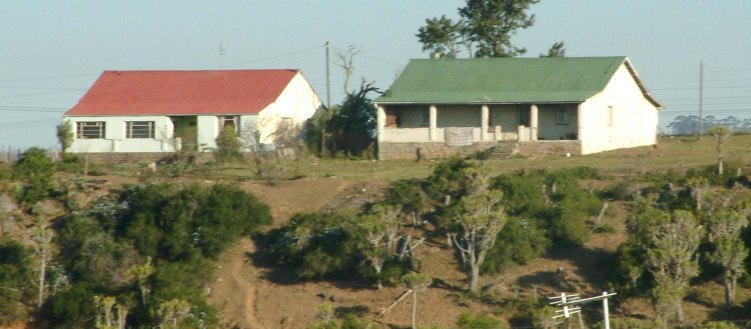 In September 1912 the Borough Engineer authorized the planting of lucerne and maize on the municipal farm for the utilization of Council stock. The farm also produced vegetables, such as, pumpkins, tomatoes and cabbages. Cultivated plantations supplied the Council with wood. The produce was presumably sold to supplement the farm’s income. The adjacent land was hired to dairy farmers for grazing.Some of the farm tenants, who lived at Bidhli for several generations, worked at the town’s sewerage works situated opposite the farm. The Russel, Smiles, Rooi, Bramwell, Fourie, Swanepoel, Flanagan and Fritz families trace their origins to Bidhli.
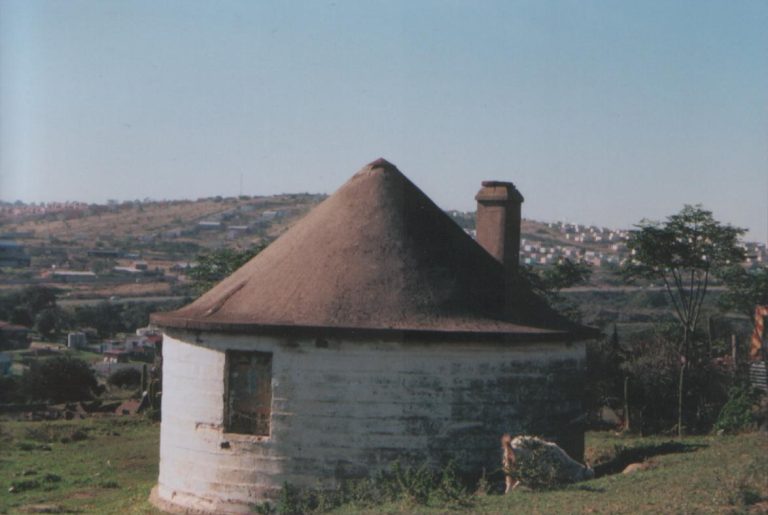
The rondavel in the photograph was built during 1920–9 by the local municipality. The walls and roof were constructed of reinforced concrete. Sixty-two similar rondavels were built in Ginsberg in 1924, but did not prove to be satisfactory. In 1929 the Borough Engineer, Mr H. M. Tait, stated that many of the roofs leaked and the cottages were far from popular among residents. The Ginsberg cottages have all been demolished and the three rondavels at Bidhli are the only extent examples.
Prior to the establishment of the experimental farm, a settlement existed at Bidhli. King William’s Town first Resident Magistrate, Richard Taylor, stated that by 1860 the town’s first locations were situated at Tsolo, which forms part of present-day Ginsberg, and Bidhli. According to Taylor, the latter fell under the headman, James Bidhli, who supervised a group of 135 men, women and children. The settlement consisted of 37 rondavels, five horses, 43 goats, three wagons, five ploughs and 19 firearms.
After 1861, the settlement was taken over from the military authorities and the newly constituted Borough Council granted sites for the construction of huts. By 1908 the residents were paying the Council 2 shillings and 6 pence per quarter for a site and the dwellings were erected by the residents at their own expense. Some sites at Bidhli were two or three acres and included gardens.
 In 1906 the Council decided to relocate Bidhli residents to the Ginsberg municipal location. The Council subsequently prohibited the transfer of dwellings at Bidhli following death or removal from town and no new sites were granted at the settlement. In 1914, on behalf of Bidhli residents, Mr J. T. Jabavu submitted a petition to the Council stating that the settlement, consisting mostly of third generation tenants, was well-behaved and respectable. Jabavu suggested the retention of the small allotments and the extension and development of Bidhli into what might become ‘a model for municipal corporations’. However, Jabavu’s advice went unheeded and the last Bidhli residents were probably moved to Ginsberg. By 1912 the Council’s experimental farm was firmly established in its stead.
Sources:
Burton, A. W. King William’s Town in the British Kaffraria, VOL. 1, 1967, p. 55.
Cape Archives 3/KWT vol. 4/1/149 ref. J 5/6: Petition on behalf of residents of Bidhli by J. T. Jabavu, 09.10.1914
Interviews with C. Rooi & J. Smiles 24.04.2006.
Cape Mercury, 18.08.1908, 09.07.1912, 17.09.1912, 23.09.1912, 15.10.1914, 26.10.1914
Unpublished document, Cory Library for Historical Research.