

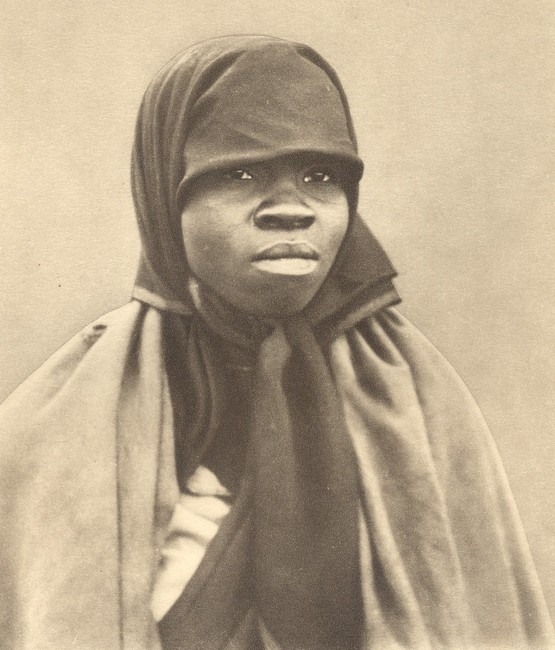
 The photograph depicts the style of headdress worn by a wife until she has borne her first child. Before that event, she may not approach a hut directly by crossing the courtyard (inkundla), i.e. the space between the huts and the cattle-fold (ubuhlanti), but must go round and approach it from the back.
Xhosa brides were taught to dress in such a manner as to show respect (ukuhlonipha) to their in-laws. They were even taught not to look men in the eye wheBriden speaking to them, even their own husbands. Such deference was a sign of respect (inthlonipho). It was disrespectful for a bride to look a man in the eye: a fine had to be paid if a bride did such a brazen thing. Concerning the headdress (iqhiya), the newly married woman (umakoti) was expected to conduct herself in a totally different manner to an unmarried woman or a woman who had been married for a long time. The umakoti does not encircle her head with a handkerchief in the usual turban-like fashion, but puts on the headdress spread out. She then takes the two front ends or corners, bends them down and ties them under her chin leaving the rest to hang down loosely on the back of her head and shoulders. She wore no flamboyant colours, but only sombre black.
In former times a bride-to-be would be taken to her new homestead (umzi) by the woman folk of her locality who formed part of the wedding procession (uduli). There she was stripped of her beads and girl’s clothing and from this time on, she would never again go round in public naked above the waist. The women smear her from head to toe with a red paste made from powdered ochre (imbola) and dress her in the style of a bride, which is quite different from that of girls or married women. These are the symbols of a bride (umakoti); she has to go about painted in this fashion until after her first child is born. Her red blankets are now draped in their own particular style and a black cloth is wrapped tightly round her head to come down over her forehead and so low over her eyes that she sometimes has to tilt her head backwards to see. Wearing such a headdress is one of the many tokens of respect a bride has to show her father–in–law. Another form of respect is that from now on she may never again say his name or use any word in which the first syllable is the same as the first syllable of his name. The bride also has to respect the names of her husband’s father and grandfather. Her husband also has to respect his wife’s parents and grandparents. A bride is given a new name and her husband plays little part in the process. The male members of her father-in-law’s family and particularly her mother-in-law name her.
The newly married bride and groom lived at her father-in-law’s homestead in a separate hut. They stayed with the groom’s parents until the newly married man built a homestead for his own family. The newly weds could only establish a new homestead when the husband had a younger brother to take his place looking after their father’s livestock. In former times it was not unusual for parents to arrange marriages for their offspring as part of a wider web of political alliances.
Photo caption:
A portrait by A. M. Duggan-Cronin, 1939.