

Among the Xhosa, the calling of the diviner (igqirha lokuvumisa) to become a healer is described in a well known myth. It is a simple but familiar tale that recurs in some of its essential details among the Nguni in general. Yet, by virtue of its simplicity, it is able to bear and convey a dense cultural and esoteric load. Significantly, the majority of Xhosa diviners are female.
 The candidate diviner strips off on the river bank and plunges into the water. Significantly, although the novice is ‘out of her mind’, she is not a potential suicide or accident victim about to drown, but goes into the river ‘as if by magic’, undressing as though she is ‘going to swim’.
Under the river, the novice encounters a snake guarding the entrance to a subterranean enclosure. The snake, which is called ichanti, is coiled beside wet, white clay (ifutha) on a grindstone. In the Bhaca version the snake is coiled round a solid piece of white clay.
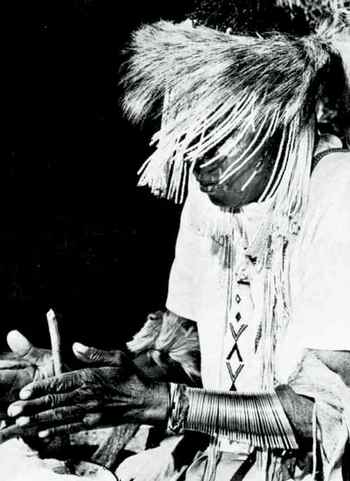
‘To be stripped off’, like the river itself, is a liminal sign denoting separation and seclusion ‘in the care of the ancestors (iminyanya)’. Diviners are apt to draw on liminal signs, such as nakedness, the river, the colour white, white clay, white beads and so on, transforming them in the process into symbols of transition signifying the change of status involved in becoming a healer. Immersion in and emergence from the river symbolizes the gradual transition in status from novice to practitioner. The diviner occupies a socially sanctioned position, which is symbolized by the healer’s ceremonial regalia of hide hat (isidlokolo) and girdle (umthika) worn at dances (iintlombe) held at the homes of clients. As with all changes in status, it occurs under the auspices of the ancestors, the supreme sanction of traditional law.
If the novice ‘belongs to the river’, then she smears the white clay on her face and body and by-passes the snake, which does not harm her. However, the snake is also the ‘messenger of death’. It kills people who try to enter but do not belong there or have a complaint against them at home. The snake bites its victim’s eyes, ears and genitals.
Having passed the snake, the novice goes through a hole in the ground and enters the enclosure beyond. It is not only like the interior of a thatched Xhosa hut or ungquphantsi, but also bears a remarkable resemblance to the interior of a healer’s medicine-hut (intondo). Medicines (amayeza, imithi), mostly barks and roots, are spread out on the floor on river reeds (imizi). There is a very old woman, with long hair, who is reputedly ‘half human and half fish’. She is a fish ‘below the waist’, which is a euphemism of respect (intlonipho) for the diviner’s girdle consisting of wild mammal pelts. Traditionally, the Xhosa did not eat fish, which were classified with snakes. Furthermore, diviners abstain (ukuzila) from eating the highly desirable and socially acceptable meat of the various antelopes and chacma baboon, for example, the pelts of which are worn in the regalia.
The old female diviner is the representative of the ancestors of the agnatic group or clan (isiduko) who initiates diviners under the river. Every clan ‘belonging to the river’ reputedly has its own initiating old female healer under the river.
She tells the novice that the ancestors have called her to become a healer. “Go home now”, she says, “Heal your and other people.”
Like someone being physically reborn, the novice passes out through the hole in the river bed and returns to the surface of the river. The novice stays there a moment and then sinks down, and this continues for three days. On the third day, when the fermented sorghum beer (utywala) is ready at home, siblings and relatives find the novice, who is covered from head to foot in white clay and to this extent resembles a disinterred corpse (isithunzela).
The candidate diviner is accompanied home, where people are already dancing, and placed in a separate shelter, which is called intondo, containing a tin beaker of freshly churned ubulawu roots, which are frothy white. The initiating diviner instructs the novice to drink from the beaker. Afterwards, the novice relates her experiences ‘under the river’ to the diviner.