


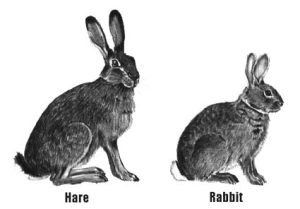
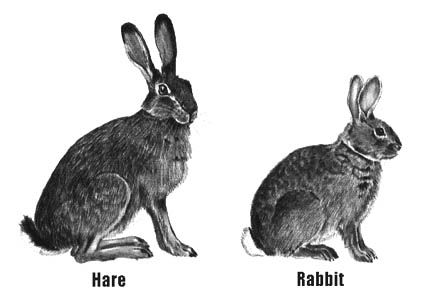
Hares and rabbits are small, shy, furry mammals found in nearly all parts of the world and classified as Leporidae. They have been valued for centuries as food and for their fur. Domestic breeds are popular as pets. They are also used for experimental purposes in laboratories. Although they have long incisors like rats and mice, they are not rodents. They are lagomorphs, which are distinct from rodents because they have a second set of incisors, though they look alike and are often mistaken for one another. They have fewer similarities than differences. At first glance, it is easy to mistake a hare for a rabbit particularly at a distance. Distinguishing marks are the hare’s longer, black-tipped ears and longer, more muscular hind legs.
 Similarities
They are similar in that:
- They have short tails.
- Each has a split lip, or harelip, although there are slight differences.
- They are prey animals that rely on hiding or running to evade predators.
- Both breed prolifically, bearing four to eight litters each year.
- Although hunters value them as game for food and fur, they are also pests to farmers and gardeners because they can destroy crops and trees.
Differences
Hares and rabbits differ in both physical features and lifestyle.
Physical features:
- Hares are generally larger and faster than rabbits.
- Hares have longer ears and larger feet than rabbits.
- Hares have very long and strong hind legs, more so than rabbits.
- Hares have black markings on their fur.
- Rabbits are altricial, i.e. their young are born blind and hairless. By contrast, hares are precocial, i.e. their young are born with hair and are able to see. Young hares are able therefore to fend for themselves very quickly after birth.
- A young hare is called a leveret and a young rabbit is called a kitten or bunny.
- They both molt and then grow new hair, in spring and fall respectively. Rabbits’ brown summer fur is replaced with greyer fur. Hares, especially those living in snowy regions, turn white in the winter.
- Hunters say that hare has a much gamier flavor than rabbit, which tastes similar to chicken.
Lifestyle:
- Hares have not been domesticated, while rabbits are often kept as pets.
- All rabbits, except the cottontail rabbit, live underground in burrows or warrens, while hares live in nests above ground, as does the cottontail rabbit. Hares rely on running, rather than burrowing, for protection.
- Rabbits are very social animals and live in colonies. Male rabbits even fight in the group for dominance. The dominant male rabbit then mates with most of the females. By contrast, hares have a solitary life. They pair off only for mating, with almost no fighting among them.
- Rabbits prefer soft stems, grass or vegetables; hares eat harder food, such as barks, rinds, buds, small twigs and shoots.
References
Hickman, C. P. Jr.; Roberts, L. S. and Larson, A. 1993. Integrated Principles of Zoology. 9th Edition. Mosby-Year Book, Inc.
Skinner, J. D and Smithers, R. H. N. 1990. The Mammals of the Southern African Subregion. 2nd Edition. University of Pretoria.
The Internet.